

Artificial Intelligence
AI Governance Act vs. GDPR: The 6 Differences You Need to Understand
AI Governance Act vs. GDPR: The 6 Differences You Need to Understand
Partager


Many CIOs approached the AI Governance Act the same way they did the GDPR: map everything, document it, appoint someone responsible, and wait for the standards to become clearer.
That reflex is understandable, and partly useful. But it obscures a structural reality: the two regulations don't work the same way, don't target the same objects, and don't produce the same obligations. Conflating them risks building a compliance program that's incomplete - reassuring on paper, insufficient in practice.
In this post, we break down the 6 key differences between the AI Act's regulatory framework and GDPR, so you know exactly what's changing, what stacks on top of existing requirements, and what your IT department needs to prioritize.

In a nutshell
To successfully comply with the AI Governance Act, you first need to understand precisely what the regulation requires of you. Comparing it to GDPR is a good way to get the full picture. GDPR compliance gives you a foundation, but it isn't enough to cover the AI Governance Act. The two regulations coexist, sometimes overlap, and diverge on the essentials: their subject matter, their logic, their roles, their documentation. Here's exactly what changes, what adds up, and what your IT department needs to build on top.
Quick reminder: what is the AI Governance Act?
The world's first regulatory framework dedicated to artificial intelligence, Regulation (EU) 2024/1689 (known as the AI Act or AI Governance Act) governs the development, market placement, and use of AI systems within the European Union.
Adopted by the European Commission on June 13, 2024, and in force since August 1, 2024, it applies beyond Europe's borders: any organization whose AI systems affect people located in the EU falls under its scope, regardless of where that organization is based. It's being rolled out gradually, through December 2027.
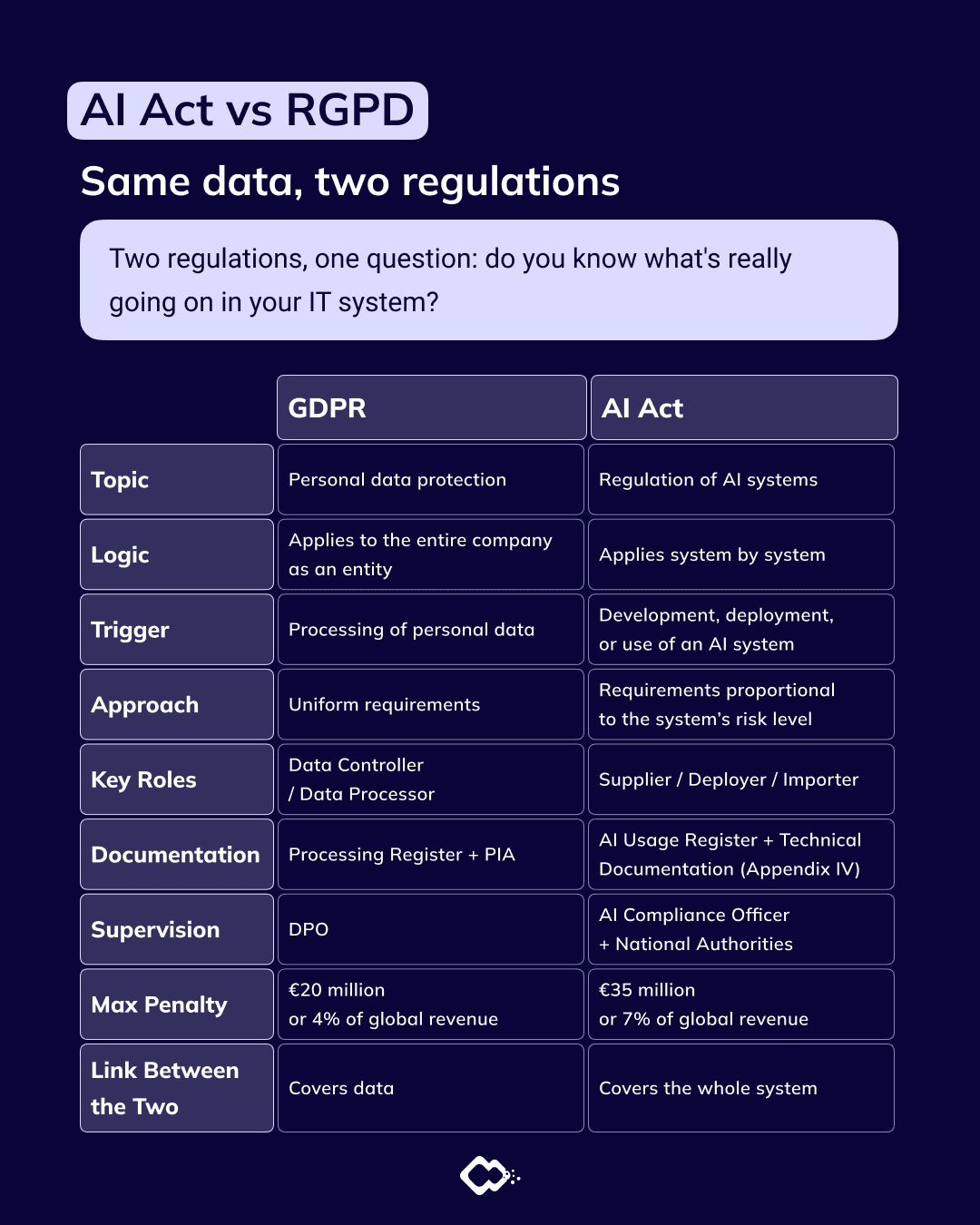
What truly sets the AI Governance Act apart from GDPR
Difference #1 - The subject matter: data vs. system
GDPR applies as soon as an organization processes personal data, regardless of the technology involved. The AI Governance Act, on the other hand, applies as soon as an AI system is developed, deployed, or used - whether or not it processes personal data.
This distinction has a direct consequence: the two regulations overlap as soon as an AI system processes personal data. An HR scoring tool, a customer service chatbot, or a generative AI API connected to a business application: all of these fall simultaneously under GDPR for the data involved, and under the AI Act for the system itself. Being compliant with one doesn't exempt you from the other.
For IT departments, this means a single AI initiative can trigger two separate regulatory frameworks, each with its own documentation requirements, roles, and supervisory authorities. Your existing data governance is a starting point - not a safety net.

How to Ensure Compliance with the AI Act
Download the guide
Difference #2 - The logic: uniform obligations vs. risk-proportionate obligations
This is one of the most structurally significant breaks between the two texts. GDPR imposes largely uniform obligations on any organization processing personal data: consent, data minimization, individual rights, a record of processing activities. The rule applies to the entity, regardless of the nature of its processing.
The AI Governance Act works differently. It scales requirements to the risk level of each individual AI system, across four tiers:
Unacceptable risk (banned practices, in effect since February 2025)
High risk (substantial obligations)
Limited risk (mandatory transparency)
Minimal risk (no specific obligations)
A single organization can therefore face radically different obligations depending on the tools it deploys - even within the same department.
This isn't a uniform compliance logic, but a portfolio logic: qualify each system, apply the corresponding level of requirement, document the process.
For the CIO and the CIO Office, this calls for full visibility across every AI system active in the IT estate - including those adopted directly by business units without ever going through Architecture review.
To dig deeper into the subject, check out "AI Audit: How to Map Your Systems for the AI Act".

What you need for compliance
System-by-system qualification first requires knowing what's actually running in your IS. This is precisely the problem many organizations discover once they get started: business units purchase more SaaS applications than IT is even aware of. Without a comprehensive, continuously maintained inventory, the AI Act's proportional risk logic simply can't be applied.
To help with this ongoing task, Smoteo's Usage Registry and AI Value Stream Map structure this visibility: a map of every AI agent active by department, risk-level qualification, and links back to the relevant architecture and business processes.
Difference #3 - The roles: data controller/processor vs. provider/deployer/importer
GDPR structures responsibility around two main roles: the data controller, who determines the purposes and means of processing, and the processor, who acts on the controller's behalf. This framework is well known, well documented, and most IT departments know exactly where they stand.
The AI Governance Act, by contrast, introduces a different mapping of roles.
Three actors are distinguished:
The provider, who develops or places an AI system on the market
The deployer, who uses that system in a professional context — including when it's a SaaS solution purchased from a third party
The importer or distributor, who makes a system developed outside the EU available on the European market
The critical nuance: IT departments frequently hold all three roles at once. They're a provider when they develop internal tools, a deployer when they integrate market-available AI solutions, and potentially an importer when those solutions are developed outside the European Union.
Each role carries specific obligations, and purchasing a solution from a third-party provider doesn't transfer responsibility for its deployment. The provider is responsible for their system; the deployer is responsible for their use of it.
For you, this changes the nature of the conversation with your vendors: contracts, compliance clauses, and technical documentation provided by third parties become full-fledged governance artifacts - not just legal appendices.
Difference #4 - Core documentation: record of processing activities vs. AI usage registry + Annex IV
GDPR requires organizations to maintain a record of processing activities, supplemented by impact assessments (DPIAs) for processing operations that pose a high risk to individuals' rights and freedoms. This is documentation centered on the entity and its processing activities - structuring, but general in nature.
The AI Governance Act goes much further, and is far more granular.
For every high-risk AI system, the regulation requires complete technical documentation compliant with Annex IV, including:
A description of the system and its intended purpose
The training, validation, and testing data used (Article 10)
Technical architecture
Performance metrics
Cybersecurity measures
Residual risk assessment
This documentation isn't a one-off deliverable. It must be updated with every substantial modification to the system, and kept available for national competent authorities on request.
So while your existing GDPR record is a reusable foundation, it doesn't cover the level of granularity the AI Act demands.
What's more, this documentation can't be produced after the fact: it has to be built alongside the scoping and development of each system - otherwise, it isn't credible. What you don't document while designing, you won't be able to reconstruct when you need it.
What you need for compliance
AI Act technical documentation requires a structured scoping process from the very launch of each AI initiative: objectives, data used, dependencies, identified risks, human oversight measures. This level of rigor can't be improvised the night before an audit.
Smoteo's Epic Cards structure this scoping system by system, right from the initialization phase. Alongside it, the AI Agent Governance module maintains a living view of every deployed agent: use case, data involved, associated regulatory constraints, risk level. Your documentation becomes a natural byproduct of how you manage your portfolio — not an extra burden.
Difference #5 - Oversight: DPO vs. AI compliance officer + national authorities
GDPR required organizations within its scope to appoint a Data Protection Officer. It's a well-defined role, with a known scope and a clear point of contact on the regulator's side. Most IT departments know exactly who to call when needed.
The AI Governance Act doesn't create an equally clearly standardized function. But it does, in effect, require a fundamentally different kind of compliance oversight. The AI compliance officer needs genuine cross-functional authority: access to senior leadership, and standing across IT, the DPO, the CISO, Legal, and business units. This isn't a legal role: it's a governance role.
Two requirements reinforce this dimension:
The obligation for AI literacy across all staff involved in developing or deploying AI systems - mandated under Article 4, and in effect since February 2025.
National competent authorities (in France, the CNIL, the DGCCRF, and Arcom, depending on the sector) can intervene with distinct scopes depending on the nature of the systems involved.
Your department therefore needs to be able to produce, at any moment, a consolidated and up-to-date view of every AI system deployed, its risk level, and its compliance status.
That's why the AI Act can't simply be handed off to a lawyer: it has to be steered cross-functionally, with the same rigor and the same tools used to manage a complex project portfolio.
What you need for compliance
Steering AI Act compliance on an ongoing basis requires a shared source of truth covering every AI system active in your IT estate: who operates it, in what context, at what risk level, under what obligations.
With Smoteo's meta-model connecting strategy, architecture, portfolio, and delivery into one living governance model, you have permanent visibility to steer, arbitrate, and report, without having to reconstruct the information for every committee meeting.
Difference #6 - The level of sanctions and extraterritorial reach
GDPR got organizations used to significant fines: up to €20 million or 4% of worldwide annual revenue. The AI Governance Act goes further on both counts.
Fines are tiered by the severity of the violation:
Up to €35 million or 7% of worldwide revenue for violations of prohibited practices
Up to €15 million or 3% of revenue for failing to meet obligations applicable to high-risk systems
Up to €7.5 million or 1% of revenue for providing inaccurate information to competent authorities
Note that more moderate thresholds apply to SMEs and startups.
Its extraterritorial reach, meanwhile, goes even further than GDPR's. Any organization whose AI systems affect people located in the European Union falls within scope - whether it's based in Paris, London, Singapore, or San Francisco. The AI Act is de facto establishing itself as the global reference standard for AI governance, much as GDPR did for data protection.
How to Ensure Compliance with the AI Act
Download the guide
What your GDPR compliance gives you - and what it doesn't replace
If your organization has seriously invested in GDPR compliance, it already has reusable assets: a well-structured record of processing activities, methodologically sound DPIAs, an established data culture, and solid documentation and governance habits.
That head start isn't negligible — it gives you a 6-to-12-month lead over organizations starting from scratch. But it doesn't cover most of what the AI Governance Act additionally requires.
What GDPR doesn't replace:
System-by-system qualification against the AI Act's four risk levels
Granular technical documentation for every high-risk system (Annex IV)
A living AI usage registry, continuously maintained across the IT estate
Formalized human oversight for every high-risk system
Managing the AI Act's specific roles: provider, deployer, importer
AI literacy training for involved staff, an obligation in effect since February 2025
GDPR compliance gives you the method. The AI Act requires you to apply that method to a new, more granular, more dynamic object - and to do so system by system, not entity by entity. This isn't starting over; it's going further, differently.
The AI Governance Act: both a governance lever and a regulatory constraint
The AI Act formalizes, in regulatory terms, a problem many CIOs already know well: AI systems are being deployed faster than organizations can govern them. Business units adopt, vendors deliver, use cases multiply - and IT ends up mapping things after the fact that should have been scoped upfront.
In that sense, the AI Governance Act is as much an opportunity as it is a constraint. The organizations that come out ahead won't be the ones that checked the most boxes, but the ones that used this moment to build genuinely operational AI governance:
A living usage registry
Documentation produced alongside scoping
Human oversight built into delivery processes
Consolidated visibility across the entire AI portfolio
The real question isn't "how to ensure compliance with the AI Act?". It's more "how do we build an organization capable of steering its AI ecosystem over time, and accounting for it at any moment?"
Smoteo structures this governance end-to-end: continuous inventory of initiatives, system-by-system scoping, mapping of agents and their dependencies, and portfolio management within a living meta-model that connects strategy, architecture, and delivery. Spend less time reconstructing information, and gain more power to decide, arbitrate, and demonstrate compliance with clarity.
Discover how Smoteo helps you maintain your AI governance.
Practical Guide
How to Ensure Compliance with the AI Act
Deadline schedule, risk levels, and a comprehensive checklist to keep your project on track
Many CIOs approached the AI Governance Act the same way they did the GDPR: map everything, document it, appoint someone responsible, and wait for the standards to become clearer.
That reflex is understandable, and partly useful. But it obscures a structural reality: the two regulations don't work the same way, don't target the same objects, and don't produce the same obligations. Conflating them risks building a compliance program that's incomplete - reassuring on paper, insufficient in practice.
In this post, we break down the 6 key differences between the AI Act's regulatory framework and GDPR, so you know exactly what's changing, what stacks on top of existing requirements, and what your IT department needs to prioritize.
In a nutshell
To successfully comply with the AI Governance Act, you first need to understand precisely what the regulation requires of you. Comparing it to GDPR is a good way to get the full picture. GDPR compliance gives you a foundation, but it isn't enough to cover the AI Governance Act. The two regulations coexist, sometimes overlap, and diverge on the essentials: their subject matter, their logic, their roles, their documentation. Here's exactly what changes, what adds up, and what your IT department needs to build on top.
Quick reminder: what is the AI Governance Act?
The world's first regulatory framework dedicated to artificial intelligence, Regulation (EU) 2024/1689 (known as the AI Act or AI Governance Act) governs the development, market placement, and use of AI systems within the European Union.
Adopted by the European Commission on June 13, 2024, and in force since August 1, 2024, it applies beyond Europe's borders: any organization whose AI systems affect people located in the EU falls under its scope, regardless of where that organization is based. It's being rolled out gradually, through December 2027.
What truly sets the AI Governance Act apart from GDPR
Difference #1 - The subject matter: data vs. system
GDPR applies as soon as an organization processes personal data, regardless of the technology involved. The AI Governance Act, on the other hand, applies as soon as an AI system is developed, deployed, or used - whether or not it processes personal data.
This distinction has a direct consequence: the two regulations overlap as soon as an AI system processes personal data. An HR scoring tool, a customer service chatbot, or a generative AI API connected to a business application: all of these fall simultaneously under GDPR for the data involved, and under the AI Act for the system itself. Being compliant with one doesn't exempt you from the other.
For IT departments, this means a single AI initiative can trigger two separate regulatory frameworks, each with its own documentation requirements, roles, and supervisory authorities. Your existing data governance is a starting point - not a safety net.
How to Ensure Compliance with the AI Act
Download the guide
Difference #2 - The logic: uniform obligations vs. risk-proportionate obligations
This is one of the most structurally significant breaks between the two texts. GDPR imposes largely uniform obligations on any organization processing personal data: consent, data minimization, individual rights, a record of processing activities. The rule applies to the entity, regardless of the nature of its processing.
The AI Governance Act works differently. It scales requirements to the risk level of each individual AI system, across four tiers:
Unacceptable risk (banned practices, in effect since February 2025)
High risk (substantial obligations)
Limited risk (mandatory transparency)
Minimal risk (no specific obligations)
A single organization can therefore face radically different obligations depending on the tools it deploys - even within the same department.
This isn't a uniform compliance logic, but a portfolio logic: qualify each system, apply the corresponding level of requirement, document the process.
For the CIO and the CIO Office, this calls for full visibility across every AI system active in the IT estate - including those adopted directly by business units without ever going through Architecture review.
To dig deeper into the subject, check out "AI Audit: How to Map Your Systems for the AI Act".
What you need for compliance
System-by-system qualification first requires knowing what's actually running in your IS. This is precisely the problem many organizations discover once they get started: business units purchase more SaaS applications than IT is even aware of. Without a comprehensive, continuously maintained inventory, the AI Act's proportional risk logic simply can't be applied.
To help with this ongoing task, Smoteo's Usage Registry and AI Value Stream Map structure this visibility: a map of every AI agent active by department, risk-level qualification, and links back to the relevant architecture and business processes.
Difference #3 - The roles: data controller/processor vs. provider/deployer/importer
GDPR structures responsibility around two main roles: the data controller, who determines the purposes and means of processing, and the processor, who acts on the controller's behalf. This framework is well known, well documented, and most IT departments know exactly where they stand.
The AI Governance Act, by contrast, introduces a different mapping of roles.
Three actors are distinguished:
The provider, who develops or places an AI system on the market
The deployer, who uses that system in a professional context — including when it's a SaaS solution purchased from a third party
The importer or distributor, who makes a system developed outside the EU available on the European market
The critical nuance: IT departments frequently hold all three roles at once. They're a provider when they develop internal tools, a deployer when they integrate market-available AI solutions, and potentially an importer when those solutions are developed outside the European Union.
Each role carries specific obligations, and purchasing a solution from a third-party provider doesn't transfer responsibility for its deployment. The provider is responsible for their system; the deployer is responsible for their use of it.
For you, this changes the nature of the conversation with your vendors: contracts, compliance clauses, and technical documentation provided by third parties become full-fledged governance artifacts - not just legal appendices.
Difference #4 - Core documentation: record of processing activities vs. AI usage registry + Annex IV
GDPR requires organizations to maintain a record of processing activities, supplemented by impact assessments (DPIAs) for processing operations that pose a high risk to individuals' rights and freedoms. This is documentation centered on the entity and its processing activities - structuring, but general in nature.
The AI Governance Act goes much further, and is far more granular.
For every high-risk AI system, the regulation requires complete technical documentation compliant with Annex IV, including:
A description of the system and its intended purpose
The training, validation, and testing data used (Article 10)
Technical architecture
Performance metrics
Cybersecurity measures
Residual risk assessment
This documentation isn't a one-off deliverable. It must be updated with every substantial modification to the system, and kept available for national competent authorities on request.
So while your existing GDPR record is a reusable foundation, it doesn't cover the level of granularity the AI Act demands.
What's more, this documentation can't be produced after the fact: it has to be built alongside the scoping and development of each system - otherwise, it isn't credible. What you don't document while designing, you won't be able to reconstruct when you need it.
What you need for compliance
AI Act technical documentation requires a structured scoping process from the very launch of each AI initiative: objectives, data used, dependencies, identified risks, human oversight measures. This level of rigor can't be improvised the night before an audit.
Smoteo's Epic Cards structure this scoping system by system, right from the initialization phase. Alongside it, the AI Agent Governance module maintains a living view of every deployed agent: use case, data involved, associated regulatory constraints, risk level. Your documentation becomes a natural byproduct of how you manage your portfolio — not an extra burden.
Difference #5 - Oversight: DPO vs. AI compliance officer + national authorities
GDPR required organizations within its scope to appoint a Data Protection Officer. It's a well-defined role, with a known scope and a clear point of contact on the regulator's side. Most IT departments know exactly who to call when needed.
The AI Governance Act doesn't create an equally clearly standardized function. But it does, in effect, require a fundamentally different kind of compliance oversight. The AI compliance officer needs genuine cross-functional authority: access to senior leadership, and standing across IT, the DPO, the CISO, Legal, and business units. This isn't a legal role: it's a governance role.
Two requirements reinforce this dimension:
The obligation for AI literacy across all staff involved in developing or deploying AI systems - mandated under Article 4, and in effect since February 2025.
National competent authorities (in France, the CNIL, the DGCCRF, and Arcom, depending on the sector) can intervene with distinct scopes depending on the nature of the systems involved.
Your department therefore needs to be able to produce, at any moment, a consolidated and up-to-date view of every AI system deployed, its risk level, and its compliance status.
That's why the AI Act can't simply be handed off to a lawyer: it has to be steered cross-functionally, with the same rigor and the same tools used to manage a complex project portfolio.
What you need for compliance
Steering AI Act compliance on an ongoing basis requires a shared source of truth covering every AI system active in your IT estate: who operates it, in what context, at what risk level, under what obligations.
With Smoteo's meta-model connecting strategy, architecture, portfolio, and delivery into one living governance model, you have permanent visibility to steer, arbitrate, and report, without having to reconstruct the information for every committee meeting.
Difference #6 - The level of sanctions and extraterritorial reach
GDPR got organizations used to significant fines: up to €20 million or 4% of worldwide annual revenue. The AI Governance Act goes further on both counts.
Fines are tiered by the severity of the violation:
Up to €35 million or 7% of worldwide revenue for violations of prohibited practices
Up to €15 million or 3% of revenue for failing to meet obligations applicable to high-risk systems
Up to €7.5 million or 1% of revenue for providing inaccurate information to competent authorities
Note that more moderate thresholds apply to SMEs and startups.
Its extraterritorial reach, meanwhile, goes even further than GDPR's. Any organization whose AI systems affect people located in the European Union falls within scope - whether it's based in Paris, London, Singapore, or San Francisco. The AI Act is de facto establishing itself as the global reference standard for AI governance, much as GDPR did for data protection.
How to Ensure Compliance with the AI Act
Download the guide
What your GDPR compliance gives you - and what it doesn't replace
If your organization has seriously invested in GDPR compliance, it already has reusable assets: a well-structured record of processing activities, methodologically sound DPIAs, an established data culture, and solid documentation and governance habits.
That head start isn't negligible — it gives you a 6-to-12-month lead over organizations starting from scratch. But it doesn't cover most of what the AI Governance Act additionally requires.
What GDPR doesn't replace:
System-by-system qualification against the AI Act's four risk levels
Granular technical documentation for every high-risk system (Annex IV)
A living AI usage registry, continuously maintained across the IT estate
Formalized human oversight for every high-risk system
Managing the AI Act's specific roles: provider, deployer, importer
AI literacy training for involved staff, an obligation in effect since February 2025
GDPR compliance gives you the method. The AI Act requires you to apply that method to a new, more granular, more dynamic object - and to do so system by system, not entity by entity. This isn't starting over; it's going further, differently.
The AI Governance Act: both a governance lever and a regulatory constraint
The AI Act formalizes, in regulatory terms, a problem many CIOs already know well: AI systems are being deployed faster than organizations can govern them. Business units adopt, vendors deliver, use cases multiply - and IT ends up mapping things after the fact that should have been scoped upfront.
In that sense, the AI Governance Act is as much an opportunity as it is a constraint. The organizations that come out ahead won't be the ones that checked the most boxes, but the ones that used this moment to build genuinely operational AI governance:
A living usage registry
Documentation produced alongside scoping
Human oversight built into delivery processes
Consolidated visibility across the entire AI portfolio
The real question isn't "how to ensure compliance with the AI Act?". It's more "how do we build an organization capable of steering its AI ecosystem over time, and accounting for it at any moment?"
Smoteo structures this governance end-to-end: continuous inventory of initiatives, system-by-system scoping, mapping of agents and their dependencies, and portfolio management within a living meta-model that connects strategy, architecture, and delivery. Spend less time reconstructing information, and gain more power to decide, arbitrate, and demonstrate compliance with clarity.
Discover how Smoteo helps you maintain your AI governance.
Practical Guide
How to Ensure Compliance with the AI Act

About the Author
Eric Draperi
Cofounder @ Smoteo
I’ve spent most of my career making sense of complex information systems. I started out as an omnichannel architect, working with organizations facing a familiar challenge: connecting business and IT without sacrificing agility or clarity. I’ve been involved in multiple digital transformations, always driven by the same belief: an architecture only matters if it truly supports strategy and value creation.
About the Author
Eric Draperi
Cofounder @ Smoteo
I’ve spent most of my career making sense of complex information systems. I started out as an omnichannel architect, working with organizations facing a familiar challenge: connecting business and IT without sacrificing agility or clarity. I’ve been involved in multiple digital transformations, always driven by the same belief: an architecture only matters if it truly supports strategy and value creation.
Focus on What Matters
Everyone Drives Change, Smoteo Connects the Dots
Whatever your role - CIO, Architect, PMO, or Product Owner - we've got your back
Everyone Drives Change, Smoteo Connects the Dots
Whatever your role - CIO, Architect, PMO, or Product Owner - we've got your back